BAIQONYR
BAIQONYR track top
40 000 ₸
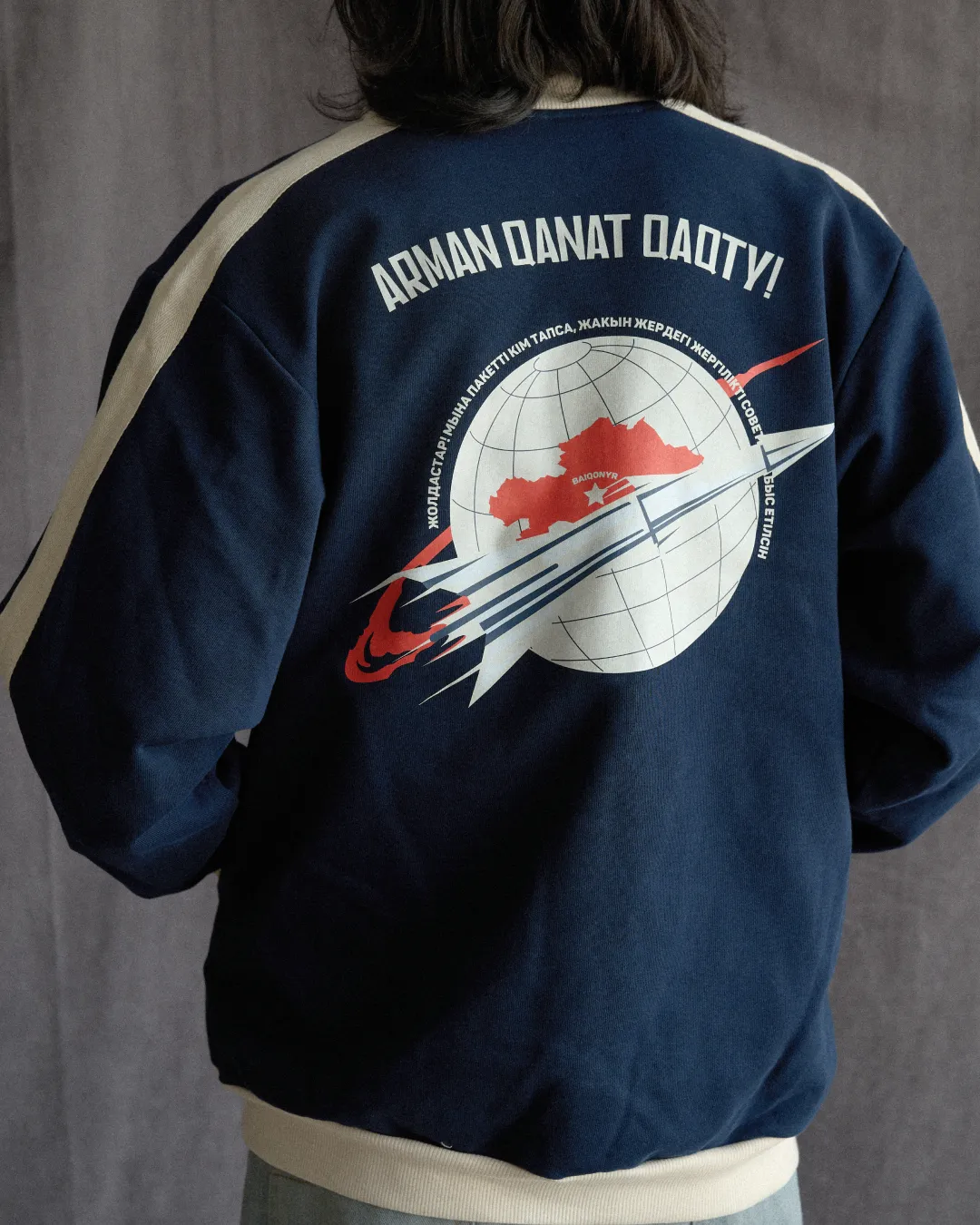
«Арман қанат қақты». Kazakh was among the first languages to sound in space.
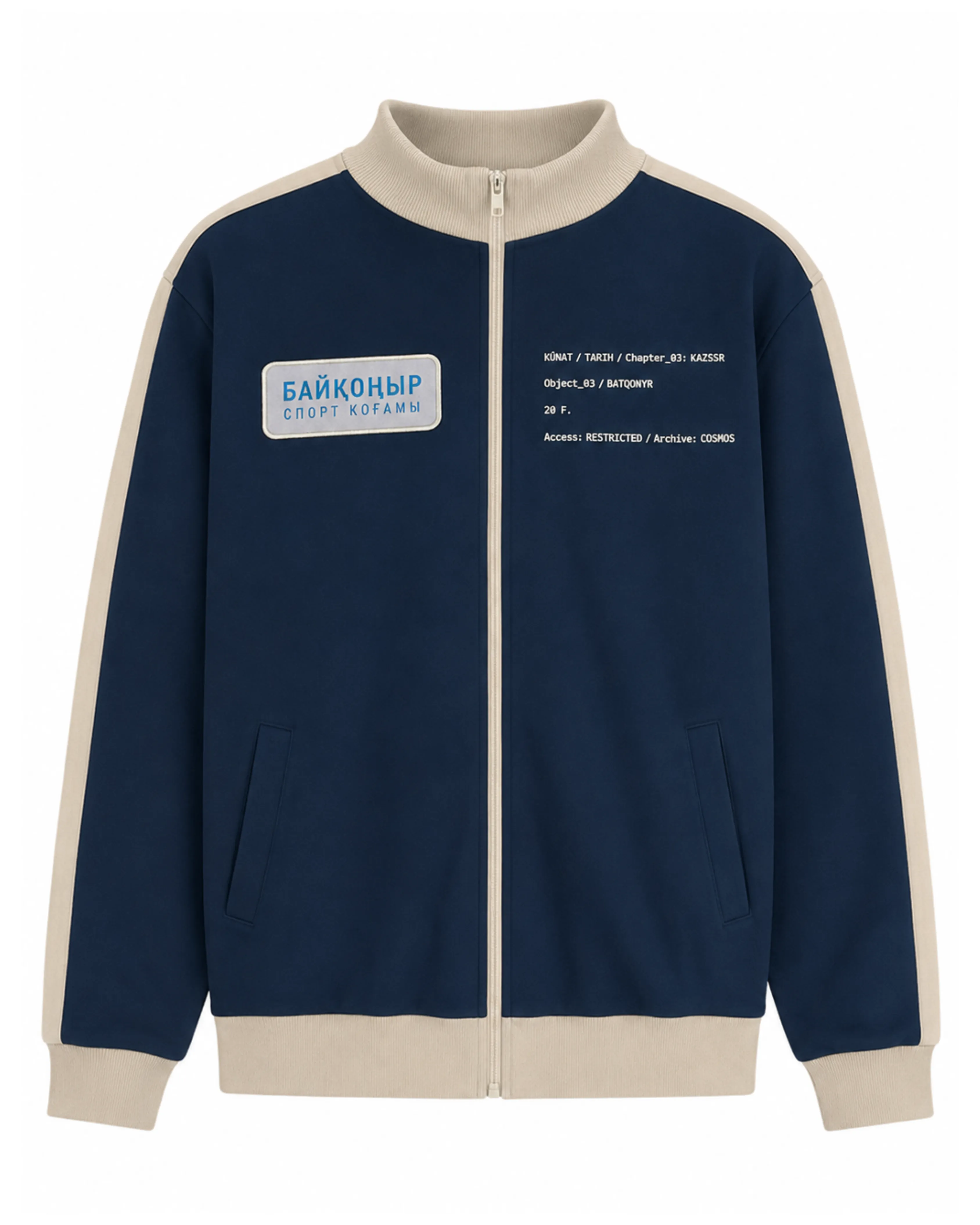
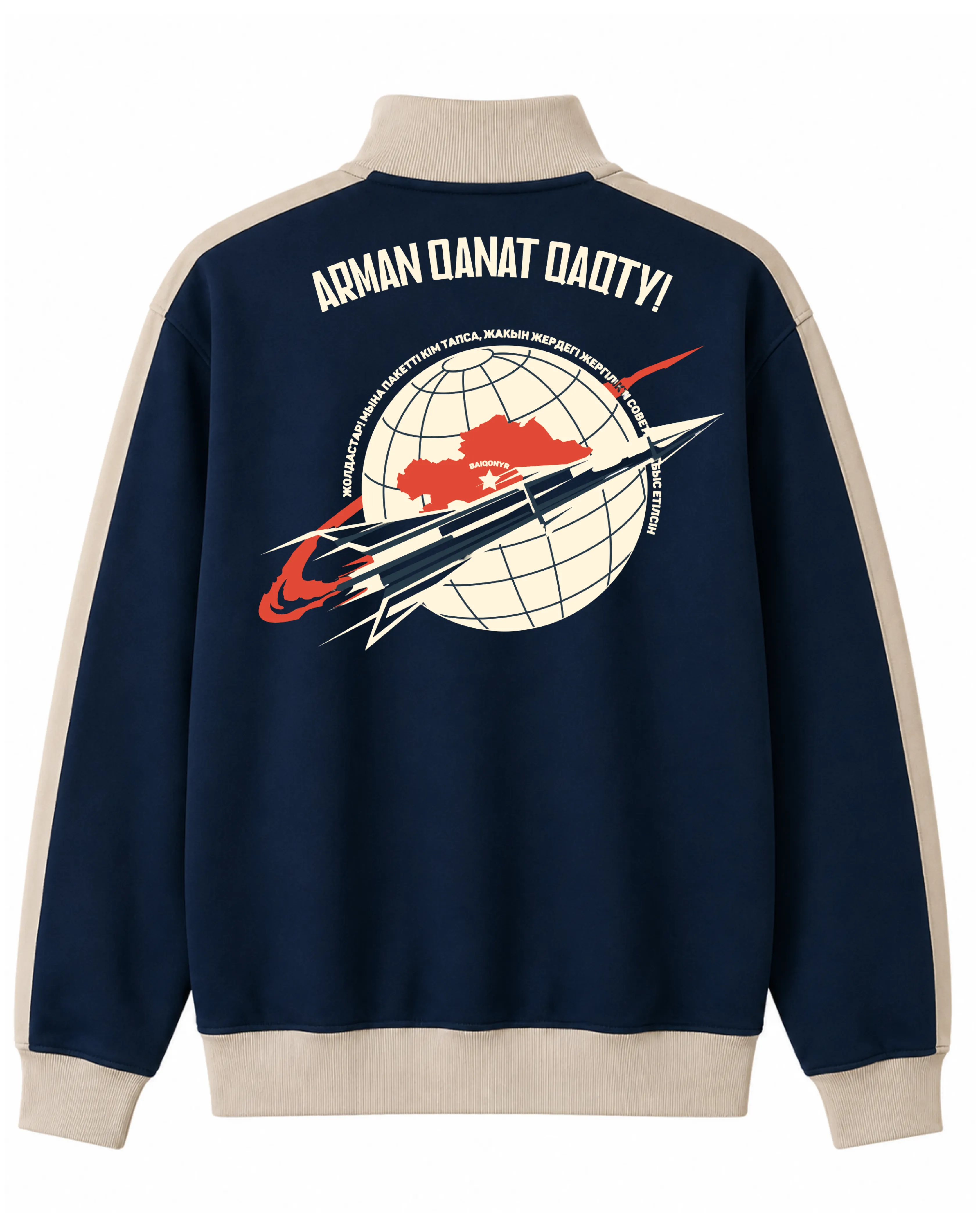
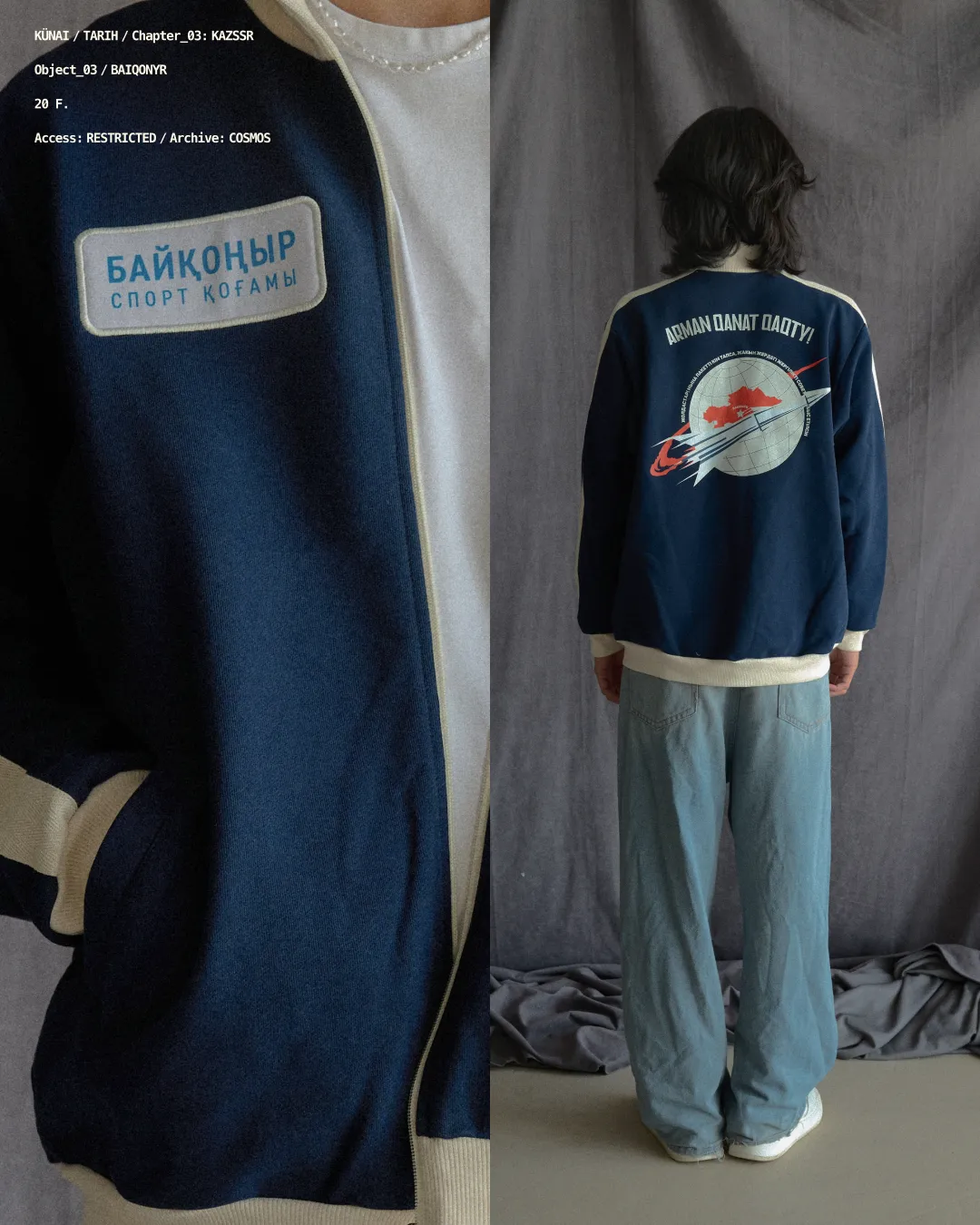
A bomber of the sports collective of the Baikonur cosmodrome. On the back, a graphic after Gagarin’s poster “The fairytale came true”.
Size chart
| Size | Shoulders | Sleeve | Chest | Length |
|---|---|---|---|---|
| S | 48 | 62 | 53 | 65 |
| M | 48 | 62 | 58 | 67 |
| L | 49 | 62 | 63 | 69 |
| XL | 50 | 63 | 66 | 75 |
garment measurements, cm
The Baikonur Cosmodrome and Soviet space agitprop: Kazakhstan as the geographic beginning of the space age, and Kazakh among the first languages to be spoken in space.
Within the sports theme, a Baikonur sports-club bomber, its back composition drawn from Gagarin's poster «Сказка стала былью» ("The fairy tale has become reality").
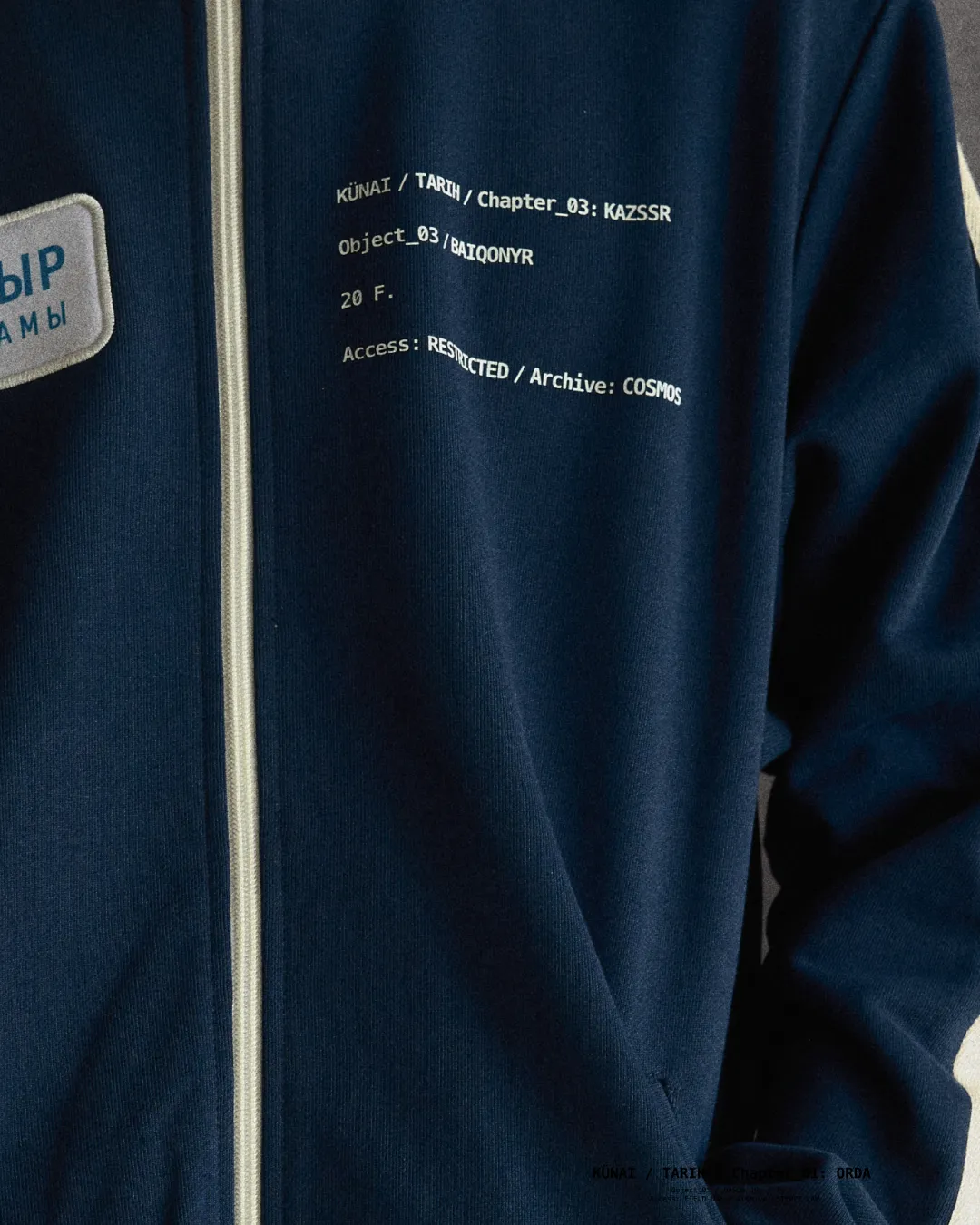
A dark blue zip track top with a stand collar and cream stripes; on the back, space graphics in the manner of early-1960s Soviet posters, with the line «Арман қанат қақты!» and the Kazakh phrase from early spacecraft. This is a fictional uniform. Any resemblance to existing clubs, names, or symbols is coincidental.

BAIQONYR
Source
Among the legacies of the Soviet era that many Kazakhstanis rightly take pride in is the Baikonur Cosmodrome. Kazakhstan is the cradle of humanity’s first steps into space. A curious detail: Kazakh was among the first languages to be spoken in space. On early Soviet spacecraft, instructions and warnings were always duplicated in Kazakh, in case a craft fell into the steppe and was found by local residents.
A second source of inspiration is Soviet agitprop. It has, without question, a dark side of ideological propaganda, yet its artistic value cannot be denied. Soviet agitprop held a visual power of a particular kind: inspiring and unsettling at once, abstract and at the same time concrete. One of the foundations for the Baiqonyr graphics was the Soviet space poster, executed in a constructivist manner and calling on humanity to continue its path to the stars.
Baikonur is at once a technical structure and a symbol. Technical: a test range established in 1955 in the Kyzylorda region on the basis of a set of parameters, a latitude relatively southern for Soviet territory (which saves energy on orbital launch thanks to the Earth’s rotation), an arid climate, and low population density. Symbolic: the point from which a human first in history passed beyond the bounds of the planet, on 12 April 1961, Yuri Gagarin, “Vostok-1”. Kazakhstan became the geographic beginning of the space age.
In the 1960s an entire parallel urban civilization grew up around the cosmodrome, Leninsk, later renamed Baikonur. Engineers, military personnel, builders, and their families, tens of thousands of people living under a closed regime with their own shops, schools, cinemas, and sports clubs. It is precisely this layer, working, everyday, unceremonial, that is the true social text of Baikonur. The phrase “sports club of the cosmodrome” is not an invention but a real genre of Soviet life.
Agitprop as a visual system has deep roots. From Rodchenko, El Lissitzky, and Klutsis in the 1920s to the space posters of the 1960s, it forms a continuous school. Its devices, diagonal composition, slogan typography, a monumental figure at the center, radiating perspective, became the shared visual vocabulary of the era. Gagarin’s «Сказка стала былью» (“The fairy tale has become reality”) is its most laconic formula: one line, one rocket, one gaze into the sky. We turn to this language not out of nostalgia but as historical material, and we shift its focus toward a Kazakhstani optic.
Interpretation
Remaining within the sports theme, we looked for a form capable of revealing the significance of Baikonur through that angle. The solution: a bomber of the Baikonur sports club. Space is a synonym for this city, and the Baikonur team would of course have worn space graphics on its back. So a composition was born, inspired by Gagarin’s famous poster «Сказка стала былью» (“The fairy tale has become reality”).
Object
Track top “BAIQONYR”. A dark blue zip bomber with a high stand collar. Cream sporting stripes run along the sleeves. The hem and cuffs are made of light elastic ribbing. The silhouette follows the sportswear of the 1960s.
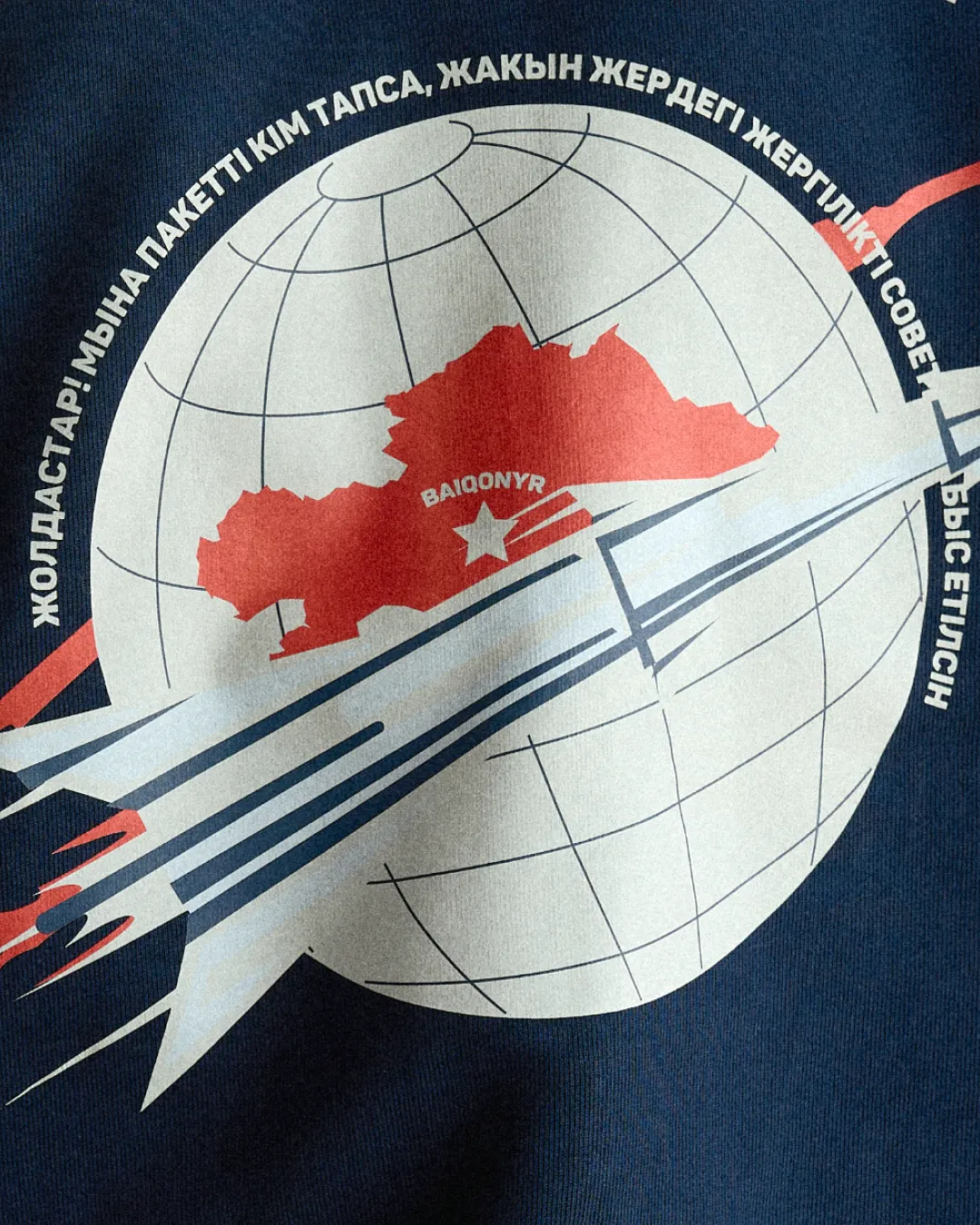
On the back, a large graphic executed in the manner of actual Soviet space posters of the early 1960s. The project draws on the compositional devices and visual language of authentic agitational posters of that period (a dynamic rocket, a radiating composition, slogan typography), reworked with an emphasis on the Kazakhstani context.
Top inscription: «Арман қанат қақты!» (“The dream took wing”).
At the center, a globe with the territory of Қазақстан highlighted and the point of Baikonur marked. A stylized rocket runs through the composition.
Around the circumference is a historical phrase in Kazakh: «Жолдастар! Мына пакетті кім тапса, жақын жердегі жергілікті советке табыс етілсін». Russian translation: «Товарищи! Кто найдёт этот пакет, пусть сдаст его в ближайший местный совет». (“Comrades! Whoever finds this package, let it be handed over to the nearest local soviet.”)
This inscription was used on early Soviet spacecraft, including the first satellites, and became one of the first instances of the Kazakh language appearing in space, making Kazakh, together with Russian, the first language to have been in space.
The project refers directly to real Soviet posters and uses their visual system as a historical source, shifting the focus to the territory of Kazakhstan and the role of Baikonur in the history of space.